 Thank you so much for following this blog about animals and animal communication! I wanted to let you know, however, that I have moved the entire blog to my main website and that is where new posts appear. I hope you will hop on over there to catch up and sign up to follow me at that location. And if you have a blog too, please put that in the comments there so I can check it out. Thanks so much!
Hello, Blog Followers!
Help! I’ve Been Relocated!
From here on out, my blog posts will now appear on my main web site: http://www.herbsandanimals.com/ If you’re subscribed or following me, please go there and resubscribe, I beg you! All this is being done by experts who say I should have everything in the same place, etc. for better SEO results… and all that kind of thing. Beats me. At least all former blog posts, with pictures and comments, have transferred over there successfully, so any ‘conversations’ that may be going on right now (like using Crest toothpaste for sarcoids on horses) should be readily available at the new URL address. Thanks for following, and I hope you’ll keep it up. Leta
Blotched, Botched, or Blessed? One Indian Pony’s Amazing Journey

“Lucky,” with his slaughter number attached to his left shoulder.
Lucky was named Lucky because he was dumped in the desert on the Mexican border seven months ago with about 40 other half-dead horses. How this could possibly be “lucky” sounds like a mystery, I know, but had his trailer-load of horses bound for slaughter in Mexico crossed that border, what little meat there was left on Lucky’s emaciated body would now most likely be digesting in the gut of some person in France… or flowing along the rivers of waste below the city of Paris. A noble equine life wasted.
The horses were dumped because several had a disease known as strangles, which can be a death sentence for horses, is highly contagious, and is certainly not acceptable for animals intended for human consumption. It was no doubt far cheaper for the hauler to release them into the desert than to try to sell them or park them somewhere.
We don’t know the whole story, and surely many of these horses perished, but Lucky was picked out of the herd in a holding pen by a teenage girl as a “gift” from a benefactor who often rescued some of these poor critters.
This girl herself had a rare gift with horses,  and she must have seen some spark in the eye of this little horse the day she chose him,
  even though that “eye” reflected such poor health and resignation.
Supposedly Lucky was only six, so that was in his favor. And he didn’t have strangles, so that was a double-plus. So off he went for rescue and rehab at the girl’s family’s stables, where they regularly took in as many of his kind as possible, brought them back to life, and placed them in good homes.
Fast forward to July of 2012 when Lucky arrived in Nambe, New Mexico, just north of Santa Fe, and was picked up by his new owner, my dear friend Cindy. Cindy had been looking for an appropriate companion for her only-horse, Nova, and, once again, there was just something about Lucky’s pictures that made her staunchly committed to giving him a permanent, forever home. He had been through months of rehab with his rescuers, Cindy’s friends, and had even recently survived a life-threatening round of severe colic. But Cindy never waivered. She was absolutely, positively sure that he was the one for her and her four-year-old mare, Nova.
Cindy began researching the little guy, posted pictures of the strange markings on his left side, and thereby learned much about his probable heritage. She found out that these marks are known as “blotch brands” and are Navajo in origin. (Cindy says they should be called botched brands because they are so messed up–no doubt due to improperly restraining the horse during branding.) The hip brand traditionally has three overlaid images which reflect the tribe, the land, and the family of the horse, so it’s easy to see how that brand alone could easily be “smeared” and hard to read. There are also often many other smaller markings/blotch-brands on a Navajo pony, of which Lucky has at least two, one of which looks like a face.
One Navajo horse trainer offered further description: “If you can ride him bareback with a halter, and he can’t back up, then he’s off the Navajo Reservation.” Later, responding to Cindy’s horrified message that this horse had been sold for slaughter, probably for $100 or less, he said, “You haven’t seen poor until you’ve been on the rez.”
Due to the drought, hay prices, and the economy, horses are being given away, sold for slaughter, or just turned loose these days by folks who are far more prosperous than those on the rez, so no, it is no wonder that Lucky ended up on that truck bound for Mexico. Still, I like to imagine little children on him, riding bareback with just a halter, and that his family was bereft to give him up. But that $100 sale price to them probably meant at least a few months of staples for their larder. It’s hard for any of us reading this to relate to that, but it certainly is a fact of life for many, and definitely for many of those among the Native American population of our country.
So Lucky lucked out and finally made it “home,” just one week ago. He was shaking all over as we started to unload him, but when he stepped out of the trailer, all of that went away and one could feel a total sea change in his being: he KNEW. We humans have epiphanous moments, why shouldn’t the animals? We could feel Lucky registering that this was his home, forever. It felt familiar being back in the high desert of New Mexico, and he immediately went into a place of total trust, relaxation and appreciation for the patient woman who stood murmuring quietly by his side.
In the last seven days, Lucky has flourished. He is on ten acres with one to two hours of at-liberty time each day to move freely, test the legs he hasn’t had a chance to use in a long, long time, and to graze on familiar stubbly, native desert grasses. But he also has his own pen with plenty of hay and feed. He is so thankful for this bounty that he went back into his pen, unprompted, all by himself, the first day he was turned out, after only an hour and a half. And he glues himself to Cindy whenever she is with him, following her from chore to chore, muck to muck. He knows. He had an epiphany. He understands and is grateful.
Other things Cindy has learned: Many of the rez horses date back to the original Arabian breed of ancient lore— the type that slept in tents with the Bedouins. A rare type these days because they are so calm and devoted, not as “hot” as many of their modern-day counterparts. Considering Lucky’s head, conformation, size and disposition, he certainly fits this mold. According to her vet, he is 11 years old, not six, which is just fine with her and will only help stabilize her four-year-old filly’s adolescent ways. And he has a spirit that can survive things most of us don’t even want to think about.
Lucky has been renamed “Sharif” (pronounced “Shar-EEF”) honoring all the traits he bears from his long-distant ancestry: nobility, honor, gentleness. He still needs to gain more weight and rebuild muscle, but no doubt one day soon Cindy will be able to find out if he can be ridden “bareback, with just a halter” (though by then she will have taught him to back up!).
Sharif is one of the lucky ones. So many horses, dogs and cats are being discarded these days due to lack of resources to take care of them. I hope Sharif’s story will inspire others like Cindy to step up and rescue or sponsor just one animal who would otherwise be lost. In this case, I don’t know who lucked out the most: Sharif or Cindy. She agrees.

Sharif, on his 6th day at “home,” clearly at peace after his long and difficult journey.
Animal “Walk-Ins” – A Different Kind of Reincarnation

Is this Moose, Merlin, or both?
What’s going on? The number of reincarnation cases I’ve been getting these past few weeks has been mind-boggling. Maybe it’s just a reflection of the fact that more people are believing in the fact that souls reincarnate… including animal souls. Or maybe it’s because more souls are striving to evolve more quickly by existing on our planet (which I have read somewhere). Whatever the reason, many of us are searching like mad for those special animals we have lost, hoping they come back to us SOON, so that we can continue to share this lifetime together.
To say the least, this has been a very interesting time, and one of the aspects of reincarnation that has been coming to the forefront for me lately with the animals is “walk-ins.” Moose/Merlin, to the left is a perfect example.
But first, for those who may not be familiar with the term “walk-in” as it applies to reincarnation, it simply means that one soul trades places with another soul and takes over that soul’s body, with both souls in agreement. Apparently this is more easily done when there has been an accident or a near death experience and the soul previously inhabiting the body is ready to leave. Usually one soul replaces the other, but sometimes both souls “share” the same body–again, by agreement. And, at least as far as my understanding goes, the souls are usually members of the same “soul group.”
I never thought about how this might apply to animals until a few years ago when I had my first walk-in case where a deceased dog entered another dog who was at a rescue sanctuary. The person involved was very drawn to the particular rescue dog in question, so the soul of her deceased companion zipped right in–by agreement–and co-inhabited the body of the rescu’ee, who was four or five years old at the time and was happy to share her body but not ready to leave. This was my first up-close-and-personal insight into this phenomenon and the fact that it occurs with animals as well as humans. In this case, how the departed spirit chose to display her traits and prove who she was to her person was most fascinating and very specific.
But back to Moose/Merlin. I had an inquiry (through this blog, actually) about a kitten who had come to the attention of a woman whose cat, Merlin, had crossed the Rainbow Bridge not long before. Merlin had been a beautiful black cat with great wisdom. The new kitten was black but, well, he had a lot going on. He had obviously been through major trauma and had some injuries, including a broken jaw. He was not even old enough to be weaned but had somehow found his way into our subject’s life and heart. She of course was not looking for a Merlin replacement but took the kitten in to help rehabilitate him.
And so began the story. Shortly after taking him in, she began to realize there was something special about this kitten and the way they had come together, even though he was born before Merlin departed. The kitten also exhibited a few very particular kitten traits that had been predominant in Merlin when he was a wee lad. Too much to ignore. So, while she called him “Moose” starting out, our reader feels sure that Moose is Merlin, and came back to her as a walk-in, in spite of great odds and life-threatening circumstances. And I happen to agree.
This is how it often happens. Seemingly by accident. Not in ways one could predict. If we are meant to be together, we souls have a divine knowing and understanding of how to make that happen. And sometimes, if all else fails, it’s through coming into a body that already exists, trading places, and settling down into the niche we’re meant to be in–with the person who’s waiting for us.
The Mustang Trail Horse
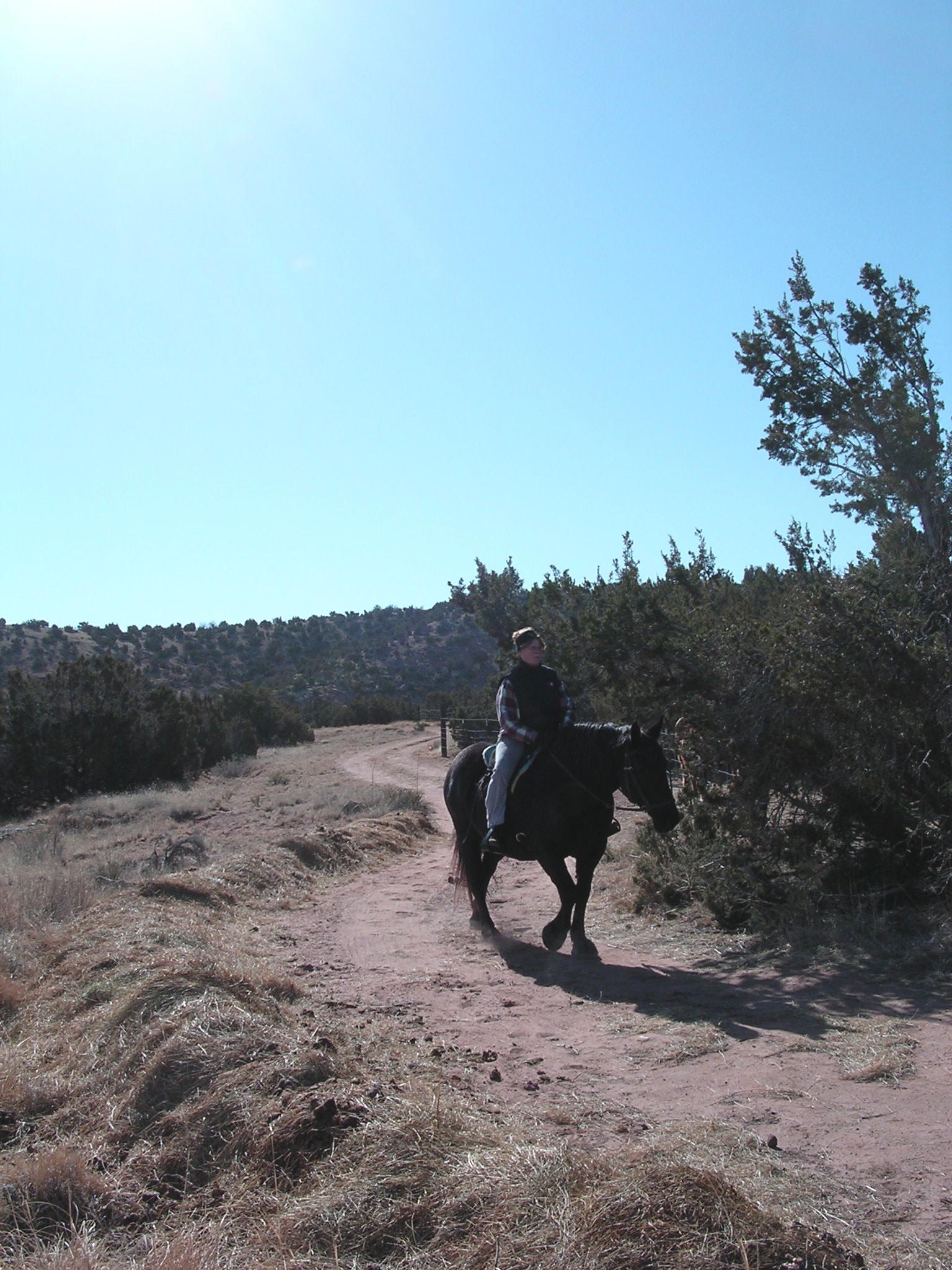
Me and my Mustang, Bella, returning from a winter trail ride.
Here’s my theory: If you have a horse who was living wild on the land before he was captured, then you have a horse who is not afraid of going out on the trail.
As any horse person knows, there are horses who are just nuts if taken out of an enclosed environment. They aren’t used to open spaces, and they’ve never been exposed to them. This is a great disappointment to many a horse owner who envisions him or herself galloping across the prairie on a noble steed.
I once had a client who decided to get back into horses after many years of “abstinance.” She shopped long and hard for just the right horse and was drawn to a beautiful Palomino at a show barn. He was a mature fellow with cool blood–not a hot breed–and had lots of training under his belt. Perfect! Or so it seemed.
Things went swimmingly for the first few months as they got to know each other, schooling and taking lessons in the arena of the barn where he was boarded. The client then decided it was time to go out on the trail. NO WAY, her beautiful boy let her know in no uncertain terms! Turned out, as nicely trained as he was, he had no trail experience.
I was called in to talk to the horse and explain to him that he would always be safe with his person, my client, and that he didn’t need to be afraid. She wanted me to tell and show him long, lazy, enjoyable trail rides together where he was completely calm.
Unfortunately it doesn’t work this way. Just because we can “talk” to an animal doesn’t mean we can reason them out of an instinctive fear or behavior. And this boy made it as clear to me as he had to his owner that he had no intention of trail riding! Try as I might, I couldn’t really make her understand this, so I fear she may have been disappointed with our session. Be that as it may…….
The point being, if you want a good solid trail horse you might just look around for a mature, well-started Mustang. They are used to being out, they know their way around, and they are surefooted and savvy. In fact, they do often have strong opinions about where they want to go and what they want to do, independent of yours, so don’t expect a trail buddy who’s like a horse from a dude string.
So pick a Mustang, honor one of our country’s greatest icons, and be ready for the ride!
*******************************************************************************************************************
If your curious or crazy about Mustangs, you might enjoy some of the following posts:
Mustangs Come in All Sizes, Shapes, Colors, and……… yes, Personalities
A Very Different Type of Mustang Personality
The More, Ahem, “Robust” Type of Mustang
How Are Wild-Captured Mustangs Different From Our Domesticated Breeds?
Quick Tips On Your Horse’s Personality Type
 “A horse is a horse, of course, of course…,” Mr. Ed sang for his theme song, but did he fit the average horse mold? Not on your life!
Horses have as diverse personalities as we humans do, and being able to identify them can really help you find your horse-match made in Heaven. One ingenious personality typing system, devised by equine veterinarian, Dr. Madalyn Ward, can be studied in her book, Horse Harmony – Understanding Horse Types & Temperaments. And you can test your horse (and yourself) for free on her site in order to see if the two of you are a good match. Dr. Ward’s system is based on ancient Traditional Chinese Medicine, which breaks down constitutional types into 11 different groups, each of which is unique in terms of what kind of nutrition, activity, training/learning methods, etc. suit it best.
Intrigued? Here are a few quick clues on identifying the personality type that best fits your horse. These are excerpted from Dr. Ward’s most recent newsletter, with permission. If you like what you see here, visit the site, take the test, and, better yet, buy the book to read about your horse’s type in depth.
Horse Temperament: 11 Quirks for 11 TypesWe list 11 quirks below, one associated with each horse temperament type. Scan through the list and see if any of these quirks rings a bell. This will help you determine your horse’s temperament type, especially if you are straddling the fence between two types!Fire: Often rolls the tongue or flaps the lips, especially when younger or under stress.Earth: When happy, often gives a contented sigh and carries an air of calm and peace.Water: When balanced, has the keen look of the eagle and is one of the most regal-looking types.Metal: Thrilled to do his job as soon as he learns it. Does a trademark grimace with his mouth when he can’t figure out his job.Wood: Loves to break things. If every gate, post, and horse toy on your place is busted or bent, you’re horse is a Wood!Shao Yang (Fire/Wood): Dislikes being touched, especially on the feet or toward the hind end.Jue Yin (Wood/Fire): Causes trouble in a playful way … loves to mess with you!Tai Yang (Water/Fire): Exuberant and loves to move … the happier he is, the faster he moves, ears pricked and exuberant! Why walk when you can trot? Why trot when you can canter?Shao Yin (Fire/Water): The most affectionate type, likely to nudge you, loving, innocent.Yang Ming (Metal/Earth): Willing to please, not very spontaneous (will give lots of warning before bucking or shying or causing trouble).Tai Yin (Earth/Metal): Very dedicated to one person, to the point of happily doing just about anything for the person they love, even if the task is difficult. Will perform for others, but not eagerly.Horse Temperament: Quirks Ring a Bell?Hopefully the above list of quirks will help you more easily determine your horse’s temperament type. Sometimes it’s the little things that our horses do that make them stand out as one horse temperament type or another.
How to Diagnose Horse Ulcers
This is a SUPER video on diagnosing whether or not your horse has ulcers.

Equine Ulcer Diagnosis by Mark dePaolo, DVM
If you have a horse who is cinchy/grouchy/touchy/spooky/rears/kicks/bites/bucks, or shows any sign of evasive, aggressive, or uncomfortable behavior, do not pass ‘go’ before you watch this video. You’ll want to get out your pen and pad and take notes. This is a short video, and the technique Dr. dePaolo recommends looks easy enough for anyone to follow. Thank you, Dr. Madalyn Ward, DVM (who specializes in holistic horse care), for bringing this to my attention so I could share it with others. Be sure and check out both her and Dr. DePaolo’s websites for more great tips on natural horse care.
EPSM, aka PSSM, aka Equine Polysaccharide Storage Myopathy – If Your Horse Ties Up or Has Other Muscular Problems It Could Be PSSM
Unfortunately, I think my Quarter Horse mare, Corazon, has this disease. And yes, it is classified as a disease and in some cases can be fatal. It afflicts mainly draft horses, warmbloods, Arabians, and, alas, the American Quarter Horse. I’ve had Corazon less than two years, and she has always had body problems, stiffness, and a resistance to moving out–even to the point of bucking when asked to canter. Her muscles also “waste”, or atrophy, quickly if she’s undernourished or can’t move enough. I’ve been doing all sorts of things to help her (including body work), and not asking too much when riding her, but when her right rear leg recently developed a pronounced “hitch,” I sought the advice of my dear friend and holistic equine veterinarian in Texas, Dr. Madalyn Ward, and she said it sounded like EPSM. (Sob!) Dr. Ward has a Quarter Horse who she suspects may also have EPSM, so she has been paying a lot of attention to this disease lately. Her horse “ties up,” which Corazon does not, but there are many other symptoms of EPSM. The following is a guest post from Dr. Ward on how to recognize the signs of and treat this insidious, often-unrecognized disease. So far the only way a definitive diagnosis can be obtained is from a muscle biopsy. Treatment is mainly through diet. If you have a horse exhibiting any of these problems, who just can’t seem to get through them, I hope this guest article from Dr. Ward will be helpful. Although this article focuses mainly on the symptom of “tying up,” treatment is the same for all EPSM symptoms. My thanks to Dr. Ward for sharing this information.

Corazon, after a recent body work treatment that we hope is making her more comfortable.
“Tying up” is one of the most common muscular problems in performance horses, although this condition can also occur in lightly-worked horses.
Signs of acute tying up are very obvious and include:
– anxiety
– refusal to move
– swelling in muscles of the hindquarters
Chronic symptoms include:
– abnormal hind leg gaits
– exercise intolerance
– muscle wasting
– back soreness
– difficulty lifting hind legs
– behavior problems under saddle
– spasmodic type colic
– elusive lameness or behavior problems
EPSM and Horses Tying Up:
Equine polysaccharide storage myopathy (EPSM) is by far the most common cause of tying up in horses. EPSM has been around for years but now it is being recognized earlier and diagnosed much more frequently. For years I have attempted to treat frustrating cases of tying up. I now realize how many of those horses probably had EPSM, and wish I had known more about it sooner.
EPSM is a genetic disorder that affects a horse’s carbohydrate metabolism. Affected horses store too much glycogen in their muscles, which they cannot break down to produce carbohydrates. Without these carbohydrates as energy sources, these muscles lack the necessary fuel during exercise. As a result the muscles must use energy from less efficient energy pathways, which produces damaging byproducts, such as lactic acid.
Conventional Treatment of Tying Up:
Conventional treatment of acute episodes of tying up includes non-steroidal anti-inflammatory drugs, sedatives, and fluids if muscle damage is severe. Signs of severe damage would include muscle swelling, heat, and pain on palpation. The horse’s urine might also turn dark since the pigment from damaged muscles passes through the bloodstream.
Holistic Treatment of Tying Up:
Holistic support for acute episodes of tying up includes giving the homeopathic remedy Arnica every 5 to 10 minutes until the horse is relaxed and able to move. Gentle body work such as TTEAM, Bowen, or Equine Touch can bring more circulation to the tight muscles. Rescue Remedy can be used to help the horse relax.
Early Recognition of EPSM:
Early recognition of the symptoms of EPSM will allow you to take steps to manage the horse so that tying up never happens. Arabians, Quarter Horses and Warmbloods are the most commonly-affected breeds, but any horse with chronic back soreness or unexplained hind limb lameness should be considered for EPSM. A muscle biopsy can confirm the condition, but often a horse’s response to diet and management changes will provide a good indicator. Horses with EPSM should not be confined to a stall. Movement is very important. A low starch, high fat and fiber diet is also critical for controlling the symptoms. Some mildly affected horses will respond to a formulated low starch feed and mixed alfalfa/grass hay. Others will need much higher fat levels–up to 20% of the overall diet.
Conventional wisdom suggests vegetable oil as the best source of fat for horses that require higher levels of this nutrient. I do not like vegetable oil because it is almost always highly processed and refined. Vegetable oil is also lacking in vitamins or minerals, so these must then also be supplemented to meet the needs of the horse. I prefer a low starch feed and a grass/alfalfa hay mix that is supplemented with high fat seeds such as flax, chia and/or sunflower. The seeds are much more natural to the horse’s diet and include other nutrients to meet the horses overall needs. Extruded rice bran that has added minerals can also be used as a fat source. If none of these diet plans bring the fat content high enough to control symptoms, then vegetable oil can be used up to 2 cups a day. Additional antioxidants such as coenzyme Q10, vitamin E, and selenium can help the horse more readily heal the damage to his muscles.
What to Expect:
Response to the low starch, high fat diet will take about 4 months, so you must be patient even if symptoms don’t appear immediately better. Signs of improvement include re-bulking of atrophied muscles, comfort when hind legs are raised, and freer movement of the hind end in general. Many EPSM horses will appear to have much higher energy on the new diet and this is mainly due to freedom from chronic muscle spasm.
Overcoming Fear and Pain in a Horse
This is something that is definitely easier said than done. And often people, even horse people, mistake fear or pain for defiance and meanness.

When I talked to this little girl a few days ago, it was hard to even get her to open up at first. She was very mistrusting and fearful, so having someone start talking to her who she couldn’t see was a pretty scary thing. She never did reveal her true, underlying personality because she was “flat” emotionally from her past experiences and dealings with humans. But she did show me lots of mental pictures and convey lots of feelings and ideas about why she behaves as she does.
I was called in to talk to this four-year-old filly because she spooked, shied, bolted, and bit—to the extreme. She had been bought from two “horse traders” not too many months ago, as a three-year-old who had been started at two, and nothing more was known about her background. Her new owner was very badly injured in an accident soon after getting her, when the filly spooked and bolted out from under her. She’d been hand-walked ever since (2-1/2 hours a day), but exhibited the same behavior even then, plus was now biting at her owner while they walked.
Not a pretty picture. Her owner was understandably afraid to ride her again, and was getting shoved and knocked around considerably by the filly during their walks. Both owner and horse were now afraid, so the filly had no strong leader to trust—a must in a horse’s natural life.
A four-year-old is still basically a baby horse, and if they’ve had a rough start like this girl, that young age is doubly stacked against them. This filly did show me that she had once been a normal, happy, frolicking foal, which gave me hope that that basic personality could still be resurrected. She showed me a traumatic weaning, very rough handling, and that she had extreme pain and restriction in her neck, which seemed to cut off neurological and circulatory function to the extent that her peripheral vision was restricted. So things coming into her vision “from the wrong place,” suddenly and unexpectedly, caused much of her spooking. Horses, being prey animals, can see peripherally almost all the way behind them, and that’s where predators come from. So it’s no wonder she freaked out all the time. And she said she was biting because her head was being jerked on, and it hurt!
Her owner, who had never consulted with an animal communicator before, and who was a novice horse-person, wanted me to explain things to the filly and simply tell her how she needed to behave. Unfortunately, it’s not that simple, though many people think it must be. It is assumed that if you can talk to an animal, you can just tell them what to do, how to be, not to be afraid, etc. No. You can’t override fear or pain via intellectual explanation. I have a bad back, and if someone told me to simply ignore the pain and carry on normally when I’m in the middle of an extreme episode, I would think they were both nuts and lacking compassion. I think it’s the same with animals. They might hear us tell them “everything is okay,” but until we can provide concrete help that engenders trust and relief, no change will occur.
For this baby I recommended much shorter walks in-hand, a non-invasive technique of body work called Ortho-Bionomy, and trainer Carolyn Resnick’s at-liberty approach designed to appeal to a horse in the horse’s own “language,” thereby building trust and confidence in both horse and owner.
When I have a session like this, no matter how detached and emotionally clear I try to stay, it always pains me to have to sign off, knowing that things could go either way. Sometimes I get feedback later; sometimes I don’t. And horses like this filly, who are in a state of pain and mistrust, are dangerous animals who often end up being passed around and suffering more and more abuse due to lack of understanding.
I hope and pray in this case that this little girl gets the help she needs, and that her human companions won’t continue to write off her behavior as intentional aggression.
Enhance Your Mental Faculties… and Maybe Your Psychic Powers Too!
 The secret is the blood-brain barrier. Sounds like something out of a horror movie, but it’s really a great thing, as you will read below. But first, here’s my personal story about how my own mental faculties and psychic powers were enhanced–within about half an hour. Seriously.
Twenty years ago a friend introduced me to a form of blue-green algae called Aphanizomenon flos–aquae (aka “AFA”) by giving me one single capsule of what’s called Omega Sun. Within 30 minutes my whole being responded. I felt like my vibratory frequency (yes, we all have one) had been raised about 100 notches, and my physical energy and mood had been enhanced equally. I felt indescribably happy, almost euphoric. It was also easier than I had ever experienced to “tune in” to the animals I talked to for clients, and to feel and receive other types of information psychically as well. Needless to say, I bought a bottle of Omega Sun and immediately signed up with Simplexity Health (then called Cell Tech) so that I could order more algae any time I wanted, wholesale, and share it with others as well.
So here’s why this amazing substance, especially in the form of Omega Sun, works so well in achieving this effect. And if you don’t want to read all the technical stuff, you can just skip to the last paragraph or two.
The blood-brain barrier is a protective network of blood vessels and cells that filters blood flowing to the brain, thereby shielding the central nervous system from contaminants. So it’s a good thing.
That said, this barrier can also have the effect of keeping out quite a few other things that might be beneficial to the brain, like nutrients in the form of less-than-perfect foods we all consume nowadays, to give just one example. Being the hungriest organ in the body, the brain voraciously desires the nutrients, but unfortunately the fillers or refined aspects of many foods prevent the good stuff from ever reaching it.
 Enter Omega Sun. Omega Sun is a form of blue-green algae known as Aphanizomenon flos–aquae, acknowledged to be the oldest complete food on the planet. This particular form, Omega Sun, has had its cell wall removed so that its inner goodness can pass through the blood-brain barrier unimpeded.
I could go on and on about the properties and benefits of Aphanizomenon flos-aquae, and how it provides just about every nutrient your body needs, in the form of a living, single-cell, raw food that is highly assimilable, but, in a nutshell: it used to grow in many fresh water lakes on earth but now flourishes in only one remaining place in Oregon, Upper Klamath Lake, where it is fed by nothing but the sun and 35 feet of volcanic deposits on the bottom of the lake. Simplexity Health Inc., a 25+ year-old company, is dedicated to nothing more than safely harvesting and preserving this amazing food, and is responsible for making it available in several different forms.
Omega Sun is just one of Simplexity’s brainchildren, and is the one that can so easily pass the blood-brain barrier and feed your brain.
This is serious brain food, folks. Really.
So if you are feeling mentally foggy, like your head is stuffed with cotton, or you want to amp up your psychic reception, try Omega Sun. You can order it right HERE, right now. Oh, and also, it may help improve your spirits dramatically if you suffer from depression. I can’t swear to this because depression isn’t one of my monsters. (But hmmm, come to think of it, maybe that’s because I’ve been taking algae for 20 years now.) Anyway, sure is worth a try.
*********************************************
Here are several more blogs about other forms of this wonderful algae and how it is suited to many other bodily needs, like digestion or arthritis…… and those of your animals as well:
Help for Those Winter Blahs, or… How to Stop Being a Couch Potato
Can Blue-Green Algae Make an Animal Smarter?
Blue-Green Algae: The Proof is in the Pudding… I Mean the Old Horse
How to Keep Your Chihuahuas & Chiweenies Happy, Healthy, & Wise

 A DAY IN THE LIFE ... of an animal communicator
